
How to Get Into the Google Map Pack (And Why It's the Most Valuable Real Estate in Local Search)
The Map Pack is where most local search clicks go — and most NWA contractors aren't in it. Here's what it is, what determines who shows up, and what you can actually do about it.

When someone in Bentonville searches "HVAC repair near me," three businesses show up in a box at the top of Google — right below the ads, above everything else. There's a map on the right. Each listing shows a name, rating, phone number, and hours.
That box is called the Map Pack. The three businesses in it get the majority of clicks. Everyone below it is fighting over what's left.
If you're not in it, you're invisible to most of the people who are actively looking to hire someone right now.
Here's what determines who gets in — and what you can do to get there.
What the Map Pack Actually Is
The Map Pack (sometimes called the Local Pack or the 3-Pack) is Google's way of surfacing the three local businesses it considers most relevant for a search with local intent — things like "plumber Rogers AR," "roofing contractor Bentonville," or "electrician near me."
It pulls from Google Business Profiles, not from websites directly. Which means if your GBP isn't set up and optimized, you're not even in the running — regardless of how good your website is.
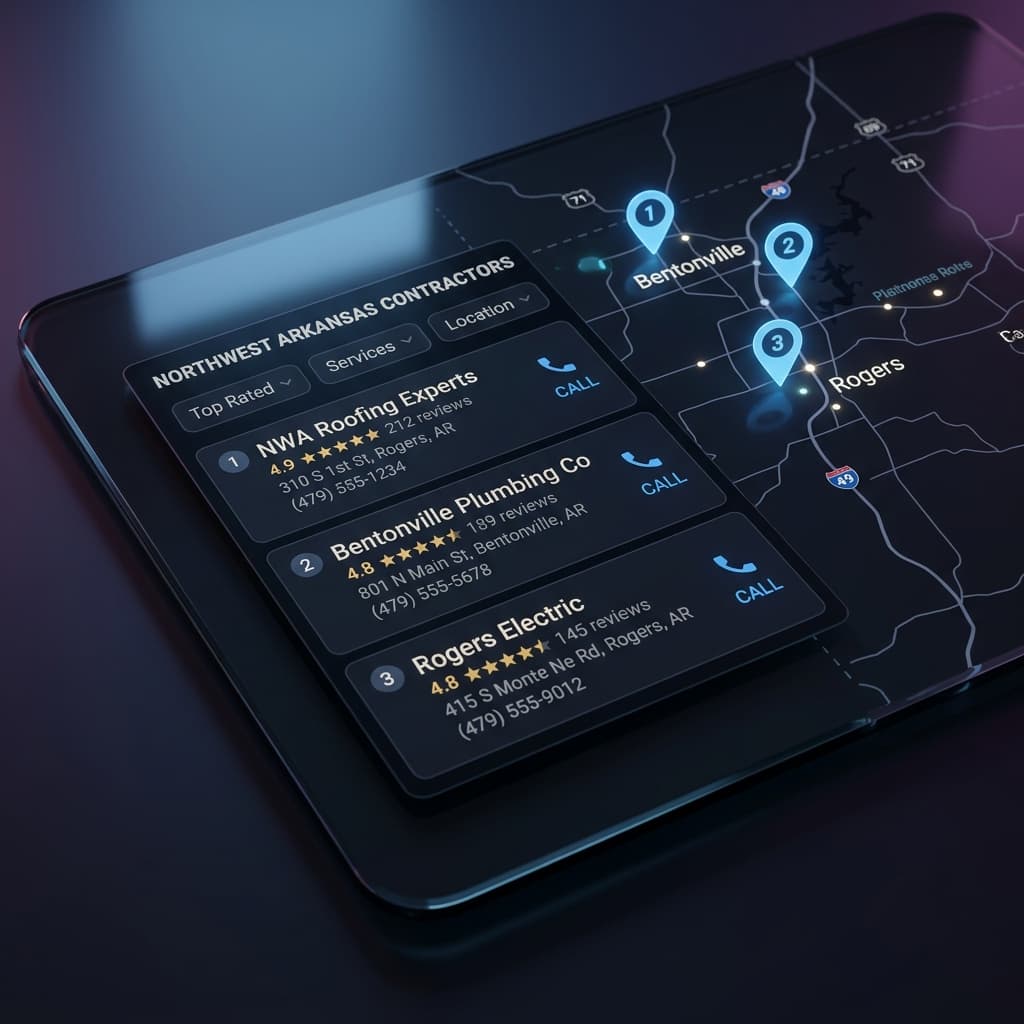
A cinematic representation of a Google Map Pack result for Northwest Arkansas, highlighting the top three local business listings.
The Map Pack shows up for nearly every local service search. It's the first thing a homeowner sees after the ads. In competitive markets like Fayetteville or Rogers, the businesses in it capture somewhere between 60–80% of the clicks on that page. The organic results below — where traditional SEO puts you — get the rest.
Getting into the Map Pack isn't a nice-to-have. For most NWA contractors, it's the difference between a phone that rings consistently and one that doesn't.
The Three Factors Google Uses to Decide Who Shows Up
Google has published the criteria it uses to rank local results. There are three of them: relevance, distance, and prominence. Understanding what each one actually means — and what you can influence — is where the real work starts.
Relevance
Relevance is how well your business matches what someone searched for. If someone searches "roofing contractor Springdale" and your GBP says you're a roofing contractor who serves Springdale, that's a strong relevance signal.
The mistake most contractors make: their GBP is set up too broadly or too vaguely. "Home services" isn't as relevant to a roofing search as "roofing contractor." The more specifically your profile describes what you actually do, the better Google can match you to the right searches.
What to do: Make sure your primary GBP category is as specific as possible. A plumber should be listed as "Plumber" not "Home Services Company." Add secondary categories for related services — water heater installation, drain cleaning, etc. Write a business description that names your services and your service cities plainly.
Distance
Distance is exactly what it sounds like — how close your business is to the person searching (or to the location they searched for). This one you can't fully control, but you can influence the edges of it.
Google uses your registered business address to calculate distance. Service-area businesses — contractors who work out of a home office or don't have a storefront — can set service areas in GBP to tell Google which cities and zip codes they cover.
What to do: Set your service area in Google Business Profile to include every city you actually work in. Rogers, Bentonville, Fayetteville, Springdale, Siloam Springs — if you take jobs there, list it. Don't pad it with cities three hours away. Google can tell, and over-extending your service area can actually hurt you in the markets where you're strongest.
Prominence
Prominence is Google's measure of how well-known and trusted your business is — both online and in the real world. This is the factor that most contractors have the most room to improve, and it's where the bulk of local SEO work is focused.
Prominence is built from a combination of things:
- Reviews: The quantity, recency, and rating of your Google reviews
- Citations: How consistently your business information appears across the web (Yelp, Angi, BBB, and hundreds of other directories)
- Backlinks: Whether other reputable websites link to yours
- Website authority: How well your site is built and optimized for local search
- GBP activity: Whether you're posting updates, answering questions, and keeping your profile active
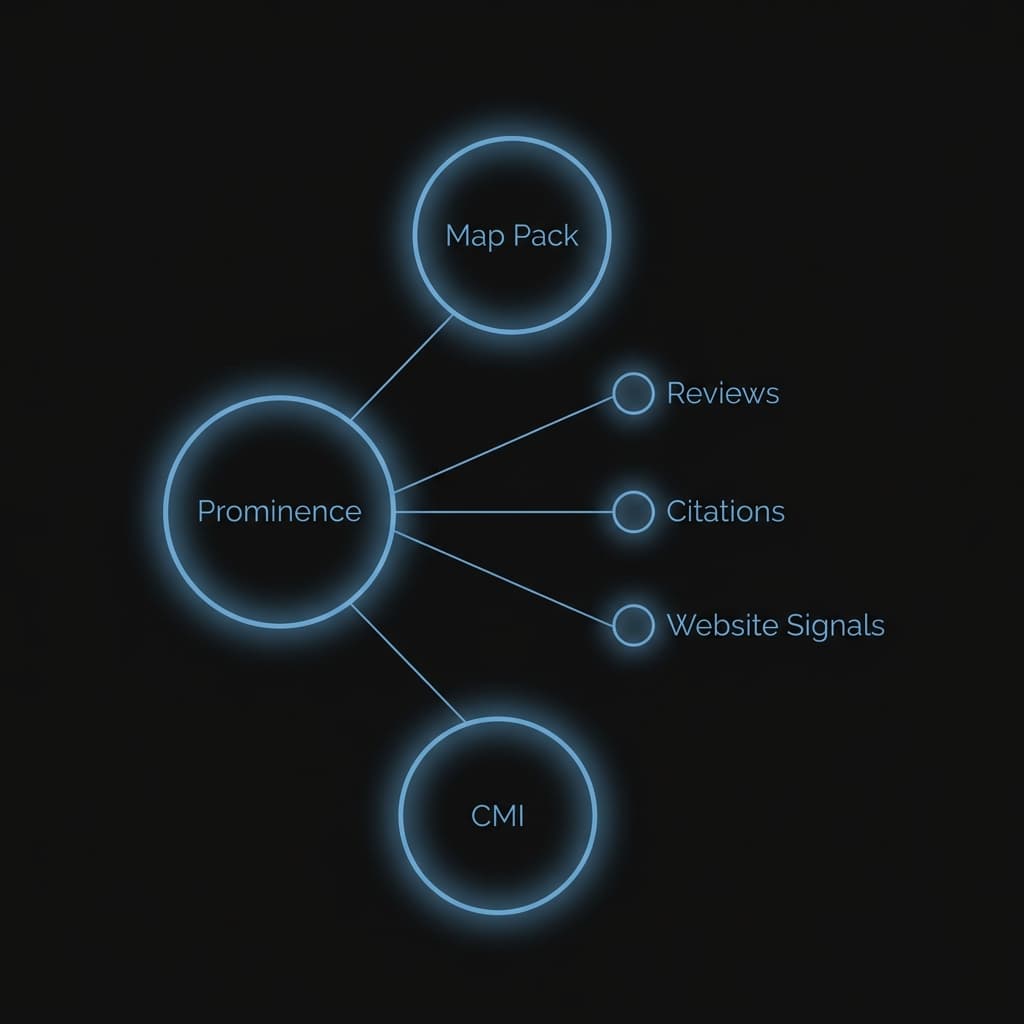
A technical diagnostic diagram illustrating the three core factors Google uses to rank local results: Relevance, Distance, and Prominence.
No single factor wins on its own. A contractor with 80 reviews but inconsistent citations and a slow website can still lose to a competitor with 30 reviews who's done everything else right. It's a cumulative score, not a single leaderboard.
The Fastest Wins for Getting Into the Map Pack
If your GBP is set up but you're not ranking, here's where I'd start — in order of impact.
1. Clean up your Google Business Profile completely. Fill in every section Google offers. Business description, services list, service areas, hours, photos, Q&A. An incomplete profile is a missed relevance signal. I wrote a full breakdown of this in How to Optimize Your Google Business Profile as a Contractor.
2. Build your review count — consistently, not in bursts. Reviews are one of the strongest prominence signals Google reads. A contractor with 5 reviews is almost always going to rank below one with 50, everything else being equal. Ask every customer the same day as the job. If you want a system for this, I covered it here.
3. Fix your citations. Inconsistent name, address, and phone number across directories confuses Google and dilutes your prominence. Angi, Yelp, Houzz, the BBB — if the information doesn't match your GBP exactly, it's a problem. I covered how to find and fix this in What Are Citations and Why Every NWA Contractor Needs Them.
4. Get your website in order. Your website supports your GBP ranking even though it's a separate thing. Google looks at your site to confirm what you do and where you do it. If your site is slow, thin on content, or doesn't name the cities you serve, it's pulling your Map Pack ranking down. Here's what your site actually needs.
5. Post to your GBP regularly. Google Business Profile has a posts feature — most contractors ignore it. Posting a project update, a seasonal tip, or a simple "now booking for summer" message once or twice a month signals to Google that your profile is active and maintained. It's a small signal, but it costs you nothing and almost no one in your market is doing it.
How Long Does It Take?
Honest answer: it depends on your market and your starting point.
In less competitive areas — Siloam Springs, Gravette, Decatur — I've seen contractors start showing up in the Map Pack within 60 days of doing the fundamentals right.
In Fayetteville or Bentonville, where you're competing against contractors who've been building their online presence for years, it can take 3–6 months of consistent work before you break into the top three. Some trades are more competitive than others — HVAC and roofing tend to be harder than, say, tile work or fence installation.
What I tell every contractor I talk to: the Map Pack isn't a switch you flip. It's a position you earn and maintain. The contractors who are in it consistently aren't doing anything magic — they're just doing the basics better, and more consistently, than the ones who aren't.
Lessons I've Taken From This
1. The Map Pack is the whole game for most local searches
Organic results exist, and SEO still matters — but for a homeowner searching on their phone at 7pm for someone to fix a busted pipe, the Map Pack is what they see first and what they act on. Everything else is secondary.
2. Prominence is the factor you can actually move
Relevance and distance are mostly set once your profile is configured correctly. Prominence is what separates two equally-configured profiles — and it's built by the ongoing work of reviews, citations, and an active web presence.
3. Consistency beats intensity
I see contractors sprint on their GBP for a month, get a few reviews, then go quiet for six months. Google reads recency. A profile that's consistently active — regular reviews, regular posts, up-to-date information — outperforms one that did everything right two years ago and hasn't been touched since.
Want to Know Where You Stand in the Map Pack?
I can pull a quick look at where your business is showing up in NWA — which searches you're ranking for, which ones you're missing, and what's most likely holding you back. It's free, it takes about 15 minutes, and there's no pitch involved.

Written by
Chad Smith
Founder of Local Search Ally. Helping NWA contractors get found on Google. Based in Siloam Springs, AR.