Your Google Reviews Are Costing You Calls — Here's Why NWA Contractors Need Specific Reviews, Not Just 5 Stars
Most NWA contractors have decent Google reviews. The problem is, 'great service!' doesn't get you calls anymore. Here's what AI is actually reading — and how to fix it.

You've done the work. You've asked customers for Google reviews. You've built up a 4.8-star rating and a decent review count. And you're still not getting the calls you expected.
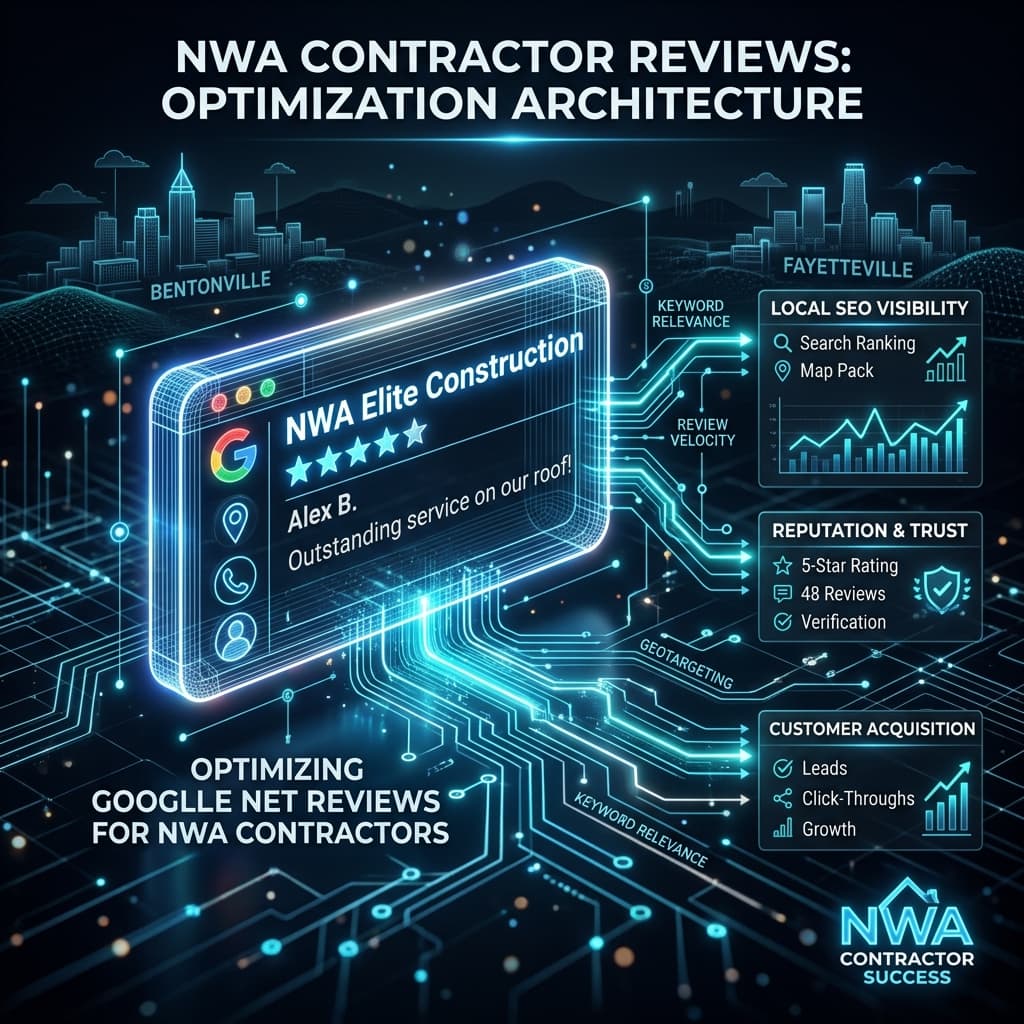
Here's what's happening: Google doesn't rank you the way it used to. The star rating still matters, but it's no longer the main signal. What Google's AI is reading — right now, on every search — is the text inside your reviews. And for most NWA contractors, that text is nearly invisible to the algorithm.
This isn't a theory. Whitespark's 2026 Local Search Ranking Factors survey — compiled from 47 local SEO experts across the country — found that review signals account for roughly 20% of local AI ranking factors. Second only to your Google Business Profile setup. The contractors showing up first in Bentonville, Rogers, and Fayetteville aren't always the ones with the most reviews. They're the ones whose reviews say the right things.
What goes into a Google Business Profile setup for NWA contractors

Why "Great Service, Would Recommend" Doesn't Move the Needle Anymore
Pull up your last twenty Google reviews. Read them straight through. Count how many mention a specific service — not just "great job" but something like "replaced our water heater same day" or "fixed the breaker panel before the home inspection." For most contractors, fewer than a third include that kind of detail.
The rest look like this:
- "Very professional, would use again."
- "Fast response, great communication."
- "Five stars, highly recommend!"
Those reviews feel good. Customers mean them sincerely. They're also nearly worthless for local search.
Google's AI doesn't count keywords the way old SEO did. It reads semantically — it understands meaning. When a homeowner in Springdale searches "who installs mini-split systems near me," the AI scans your reviews for language that confirms you actually do that work. "Fast and professional" tells it nothing. "Installed a mini-split in our sunroom in August" gives it exactly what it needs.
A plumber with 40 reviews that all say "great service" gets a generic AI summary on their Maps profile. A plumber with 40 reviews that mention "burst pipe," "water heater replacement," "same-day service," and "fixed the leak under the kitchen sink" gets a specific summary that matches emergency search queries — and shows up when those searches happen.

What Google's AI Is Actually Looking For
Google uses review text to identify what it calls "attributes" — recurring themes that define your business. These attributes feed three things that directly affect your calls:
AI Overviews — the AI-generated summaries now appearing in more than 13% of all Google searches, according to Semrush, and that number is still climbing. If your reviews don't contain specific service language, you won't be cited.
The "Known For" section on your GBP — those short descriptors that show up on your profile. They're pulled from review text patterns, not from anything you write yourself.
Google Maps AI summaries — the "know before you go" snippets that appear when someone taps your listing. Generic praise produces generic summaries. Specific reviews produce summaries that match specific searches.
The difference between third and first in the Map Pack often comes down to review quality, not review quantity. Two contractors, 60 reviews each, both at 4.8 stars. The one who gets called is usually the one whose customers described the actual job.
How the Google Map Pack works for NWA home service trades
The Language That Actually Helps — By Trade
This is where it gets concrete. What specific language looks like varies by trade, but the pattern is the same: service name, outcome, and sometimes a location or timeframe.
An HVAC contractor whose reviews mention "heat pump installation," "mini-split," or "fixed the AC before the heat hit in July" gives Google enough to match seasonal and service-specific searches. "Great HVAC company" gives it nothing to work with.
A plumber with reviews that say "fixed a burst pipe at 11 PM" or "replaced the water heater before the home inspection" matches the emergency and deadline-driven searches that NWA homeowners run when they're stressed and ready to hire. "Fast plumber, five stars" does not.
For roofers, "replaced the ridge cap after the hail storm" or "caught missing flashing during the inspection" speaks directly to post-storm and pre-sale searches — searches that happen constantly in Northwest Arkansas. For electricians, "installed an EV charger in the garage" or "upgraded the panel for the addition" attaches specific services to your profile as entity attributes. For remodelers, "handled the demo, framing, and finish work on our master bath" is the difference between a profile Google understands and one it doesn't.
The specificity doesn't have to be technical. It just has to be real.
How to Get Reviews That Actually Help You Rank
You can't write reviews for your customers. But you can have a short conversation at the end of every job that makes specific reviews much more likely.
The timing matters more than most contractors realize. The right moment to ask is right after the job is done, before you leave the property. Not a week later by email. The customer just saw the result. The work is fresh in their memory. That's when the ask lands and when the details end up in the review.

Before you ask, walk through what you did. "We replaced the pressure relief valve and flushed the tank — everything's looking good." That thirty-second recap does two things: it confirms the work in their mind, and it gives them the language to use if they write a review. Most customers don't write "replaced the pressure relief valve" because nobody told them that's what happened. Once you say it, they do.
Keep the ask short: "If you have a minute to leave us a Google review — even a couple sentences about what we did today — it helps neighbors find us when they need the same work." The phrase "what we did today" nudges them toward specifics without scripting them.
Ten reviews that mention specific services and real outcomes will outperform fifty "highly recommend" reviews in local search every time. That's not an opinion — it's how the algorithm reads text now.
How to set up a review request process for your trade business
The Faster Fix Most Contractors Miss: Respond to Every Review
Your responses are indexed. When you reply to a generic review and mention the actual service — "Thanks for trusting us with your water heater replacement, glad we got it handled before the weekend" — you've added specific language to your profile even if the customer's review was vague.
Most contractors skip responses or use a generic "Thanks for the kind words!" That's a missed signal every time.
A specific response does three things: it shows Google your profile is active, it adds service keywords to an otherwise thin review, and it tells every future visitor that you pay attention. That last one matters more than people think. A lot of homeowners in NWA read the reviews and the responses before they call. The response is part of the pitch, whether you treat it that way or not.
Google Business Profile optimization checklist for NWA contractors
The Honest Reality
Review text is one factor among several. A complete, accurate GBP still matters. A website that loads fast and clearly tells Google what you do and where you do it still matters. Consistent citations across directories still matter.
But review text is the factor most contractors are completely ignoring — not because they don't care, but because nobody told them it counted. The old advice was "get more 5-star reviews." That's not wrong, it's just not the whole picture anymore. The words inside the review carry as much weight as the rating, and the contractors who understand that are quietly pulling ahead in every NWA market right now.
Start Here
Go read your last twenty reviews. If fewer than a third mention a specific service, a specific outcome, or a location — that's your gap. The fix isn't a campaign. It's a conversation you start having at the end of every job, starting with the next one.
If you want a second set of eyes on where your Google presence stands — reviews, GBP, and citations — I offer a free assessment. No pitch attached.
Frequently Asked Questions
Does the number of Google reviews still matter for local rankings?
Volume still matters — it's not irrelevant. But Whitespark's 2026 research makes clear that review recency and the specific language inside review text now carry significant weight alongside total count. A steady stream of detailed, specific reviews outperforms a large batch of generic ones, and a profile that stops getting new reviews will start slipping behind a competitor who gets two or three a month — even if the stalled profile has more total.
Can I ask customers to mention specific services in their review?
You can recap the job before you ask — that naturally leads to more specific language. What Google prohibits is scripting the review or offering incentives. Telling a customer what you did ("we replaced the shutoff valve under the sink") is fine. Telling them what to write is not. The line is clearer in practice than it sounds.
How do review responses affect my local SEO?
Responses are indexed and add fresh content to your profile. When you reply and naturally mention the service and location, you reinforce the same language a good review would have. It also signals an active profile — which is its own ranking factor. Most contractors don't respond at all, so this is a genuinely low-effort way to pull ahead.
What makes a review useful for AI search rankings?
Specific service names, outcome language ("fixed the leak," "passed the inspection"), location references, and timeframe details ("same day," "before the weekend") are all signals AI reads to match your business to relevant queries. Vague praise like "very professional" provides nothing for the algorithm to match against a specific search.
How often should I be getting new reviews to stay competitive in NWA?
Recency matters as much as volume. Aim to build review requests into your job completion process so new reviews come in steadily — not in bursts every six months. Whitespark's 2026 research specifically calls out review recency as one of the most underrated ranking factors, and a contractor who gets two or three new reviews a month will consistently outrank a competitor who got twenty reviews two years ago and stopped asking.

Written by
Chad Smith
Founder of Local Search Ally. Helping NWA contractors get found on Google. Based in Siloam Springs, AR.