

AI Search Visibility for Contractors: The 2026 Guide
45% of consumers now use AI to find local businesses — yet 87% of independent contractors are invisible in AI results. Here's exactly what changes that.

A year ago, 6% of consumers used AI tools to find local businesses. Today that number is 45% (BrightLocal Local Consumer Review Survey, 2026). AI search visibility for contractors has become a real problem — and most haven't noticed yet. It's already happening in Bentonville, Rogers, and Fayetteville — homeowners asking ChatGPT "best HVAC company near me" and getting an answer in four seconds flat.
Here's the part most contractors haven't heard yet: 87% of independent HVAC and plumbing contractors have effectively zero presence in those AI answers (Plumbing & Mechanical Magazine, May 2026). Not a small presence. Zero. The businesses showing up are mostly national franchises.
This guide covers what's actually driving AI search results for local contractors, why proximity matters less than you think, and the six things that consistently move the needle.
For the full picture on traditional local rankings, start with the local SEO for contractors field guide.
Key Takeaways
- 45% of consumers now use AI to find local businesses, up from 6% just one year ago (BrightLocal, 2026)
- Only 1.2% of local businesses get recommended by ChatGPT; Gemini recommends 11% (SOCi Local Visibility Index, 2026)
- Distance from the searcher has essentially zero correlation with AI Overview position — correlation coefficient 0.001 (Local Falcon, 2025)
- Being cited in a Google AI Overview correlates with 35% higher organic CTR and 91% higher paid CTR (Seer Interactive, 2025)
- ChatGPT-cited businesses average 4.3 stars; 47% of consumers won't use a business with fewer than 20 reviews (BrightLocal, 2026)
Why Are So Few Contractors Showing Up in AI Search?
Only 1.2% of local businesses get recommended by ChatGPT, 7.4% by Perplexity, and 11% by Gemini — compared to 35.9% for Google's local 3-Pack (SOCi Local Visibility Index, 2026). AI visibility is 3 to 30 times harder to achieve than Google local results, and the signals that drive it are different enough that doing well on Google doesn't automatically carry over.
The gap exists because AI search and Google Maps use fundamentally different data sources. Google Maps ranks businesses based on proximity, relevance, and prominence. AI tools pull from a much wider web: review platforms, third-party directories, news mentions, schema markup on your website, and the overall pattern of how your business is discussed across the internet.
If your digital footprint is thin — a GBP, a basic website, and not much else — you're not giving AI models enough signal to confidently cite you. They'll recommend whoever they have the most consistent data on. Right now, that's usually a national chain.
ChatGPT has over 900 million weekly active users as of February 2026, doubled from 400 million a year earlier (Backlinko, 2026), and handles roughly 2.5 billion prompts per day worldwide — about 330 million of those from US users (TechCrunch, July 2025). That's a large and fast-growing share of search behavior flowing through a channel where most NWA contractors simply don't exist.
AI Platform Recommendation Rates for Local Businesses — SOCi Local Visibility Index, 2026
Source: SOCi Local Visibility Index (2026). AI chatbots surface far fewer local businesses than Google Maps — making the small share of citations disproportionately valuable.
Why does it matter if fewer than 45% of brands that dominate Google local also appear in AI recommendations? Because it means your Google rankings don't protect you here. A contractor who ranks #1 in Google Maps for "plumber Bentonville" can be completely absent when someone asks ChatGPT the same question. The two systems don't feed each other the way most people assume.
How Google AI Overviews Are Changing the Math on Contractor Searches
Google AI Overviews appeared in 40.2% of local business queries in April 2025, based on a sample of 4,423 businesses and 60,000 total queries (Local Falcon, May 2025). That's not a future feature. It's a current reality sitting at the top of results pages that used to show your organic listing.
The click math changes completely when an AI Overview is present. Being cited in one correlates with a 35% higher organic CTR and 91% higher paid CTR compared to the same query without a citation (Seer Interactive, November 2025 — 3,119 search terms, 42 client organizations, 25.1M impressions over 15 months). Not being cited when one appears is even more costly: the #1 organic result drops to a 58% lower average CTR when an AI Overview is active (Ahrefs, December 2025 — 300,000 keywords).
So if you're the top-ranked contractor in Google search and an AI Overview appears above you, you're losing more than half your expected clicks to businesses that might not even outrank you organically. That's the new competitive reality.
Not every search triggers one, though. The pattern matters.
AI Overview Trigger Rate by Query Type — Home Services (237,990 queries) — WebFX, July 2025
Source: WebFX (July 2025). AI Overviews trigger most on long, information-seeking queries — and least on "near me" searches where Google Maps dominates.
Informational queries trigger AI Overviews at 37.1%, and long-tail queries at 41.1% (WebFX, July 2025 — 237,990 analyzed queries). "Near me" queries only trigger them 12.2% of the time. That's worth sitting with for a second.
The searches most likely to produce an AI Overview aren't the "plumber near me" bottom-of-funnel searches. They're the "how do I know if my AC needs replacing" questions that come earlier in the decision process. If you're answering those questions on your website, you're a candidate to be cited. If your website only lists services and a phone number, you're not.
Does Your Location Actually Matter for AI Search Results?
The correlation coefficient between distance from the searcher and AI Overview ranking position is 0.001 — effectively zero (Local Falcon, May 2025 — 21,000 geographic data points). That's one of the most counterintuitive findings in local SEO right now, and it has real implications for NWA contractors.
Google Maps works the way most contractors expect: you're physically closer, you rank higher. If you're based in Rogers, you'll tend to outrank a Bentonville competitor for searches happening in Rogers. That proximity logic drives a lot of how contractors think about their service area.
AI Overviews don't work that way. When someone in Bentonville searches "how long does a hot water heater last," the AI doesn't weight the Bentonville plumber above the Rogers one based on their addresses. It weights them based on authority signals: review ratings, review volume, schema markup, brand mentions across the web, and the quality of content on their websites.
What does that mean practically for an NWA contractor? A Siloam Springs electrician competing for an AI citation competes on equal geographic footing with a Fayetteville electrician. The whole region is a level playing field in AI search. The contractor who builds stronger authority signals wins, regardless of where the searcher is sitting.
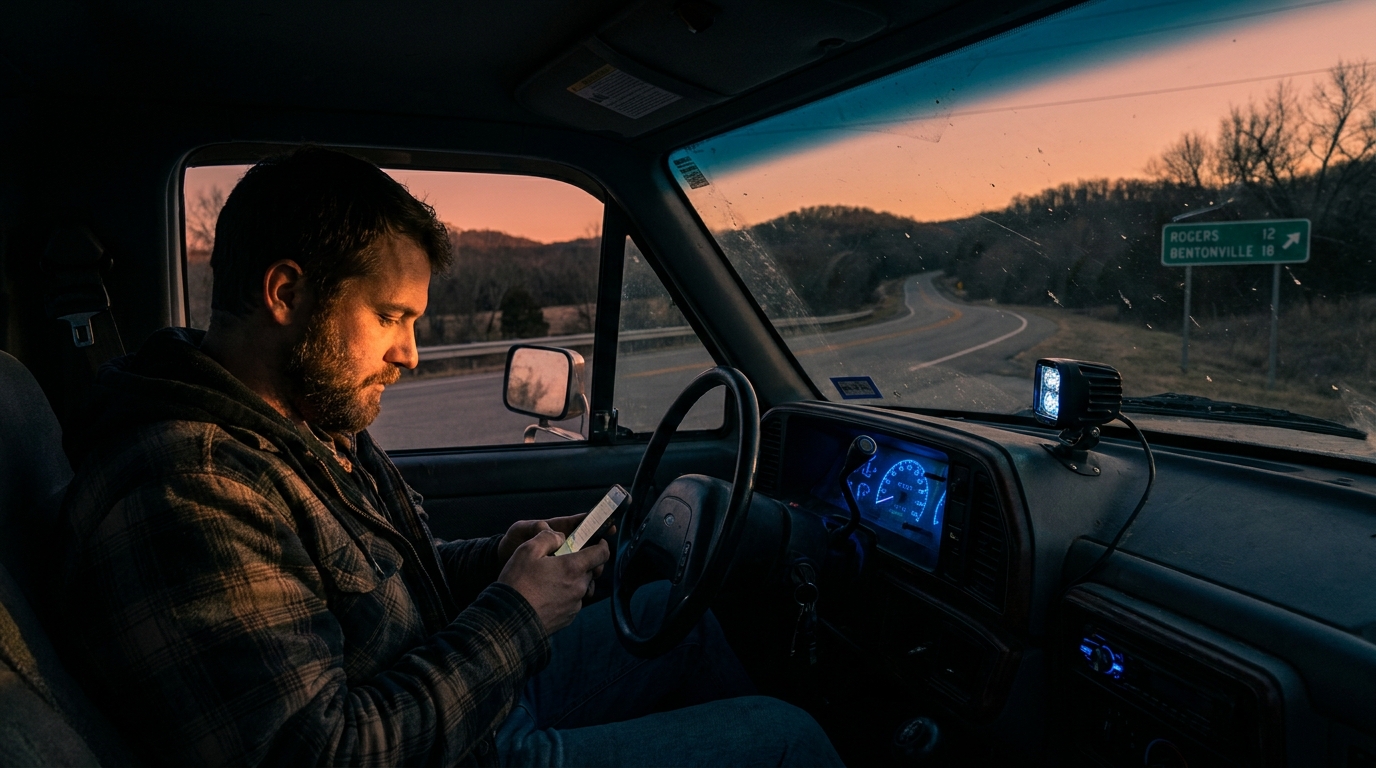
In AI search, a Siloam Springs contractor competes on equal footing with one in Bentonville. Distance from the searcher has essentially zero influence on AI citation rankings.
Why Do National Chains Dominate AI Results Over Local Contractors?
National franchises account for roughly 19% of all consumer-intent HVAC and plumbing AI citations, while 87% of independent contractors have effectively zero AI citation share (Plumbing & Mechanical Magazine, May 2026 — 65+ prompts across ChatGPT, Claude, Perplexity, and Google AI Overviews, Q1 2026). That's a stark imbalance. But the reason it exists isn't brand recognition — it's infrastructure.
National chains have review volume across hundreds of locations, structured data on every page, consistent NAP information across thousands of directories, and PR teams generating third-party brand mentions. AI models encounter them constantly during training and crawling. Independent contractors, by contrast, often have a thin web presence: a GBP, a basic website, maybe a few Yelp reviews.
Here's what the franchise advantage actually tells you: none of those signals are things you can't build. A Rogers HVAC contractor with 60 verified reviews at 4.5 stars, complete schema markup, consistent citations across 40 directories, and a website that actually answers questions — that contractor is a stronger AI citation candidate than a national franchise location with 15 reviews and a cookie-cutter landing page.
The chains have a head start. But in a market like NWA, where most independents haven't started at all, moving first matters. The AI recommendation slot for "HVAC contractor in Bentonville" isn't locked. It's just currently empty for independent contractors — and whoever fills that slot consistently will be hard to displace.
What Actually Gets a Local Contractor Cited by AI?
Reviews are the most consistently cited factor across AI platforms. ChatGPT-cited businesses average 4.3 stars, Perplexity-cited ones average 4.1 stars, Gemini 3.9 stars (SOCi Local Visibility Index, 2026). The consumer side of this is even more demanding: 31% of consumers require a minimum 4.5-star rating before using a local business — up from 17% in 2025 — and 47% won't use a business with fewer than 20 reviews (BrightLocal, 2026).
CTR Impact — Cited vs. Not Cited in Google AI Overview — Seer Interactive, November 2025
Beyond reviews, your Google Business Profile completeness affects which AI platforms can accurately describe your business. Gemini pulls directly from Google Maps and returns 100% accuracy on business information. ChatGPT and Perplexity only hit 68% accuracy (SOCi, 2026). That 32% error rate isn't random — it reflects inconsistent NAP data across the web. If your phone number is listed differently on Yelp, Angi, and your own website, AI models pick up the conflict and either cite you with wrong info or skip you entirely.
Schema markup on your website is another signal that's widely underused by contractors. Structured data tells crawlers and AI models exactly what type of business you are, what services you offer, what your service area is, and how to reach you. It doesn't guarantee a citation, but it removes ambiguity — and AI models resolve ambiguity by citing someone else.
For a full walkthrough on getting your GBP set up correctly, see my Google Business Profile setup guide for contractors.
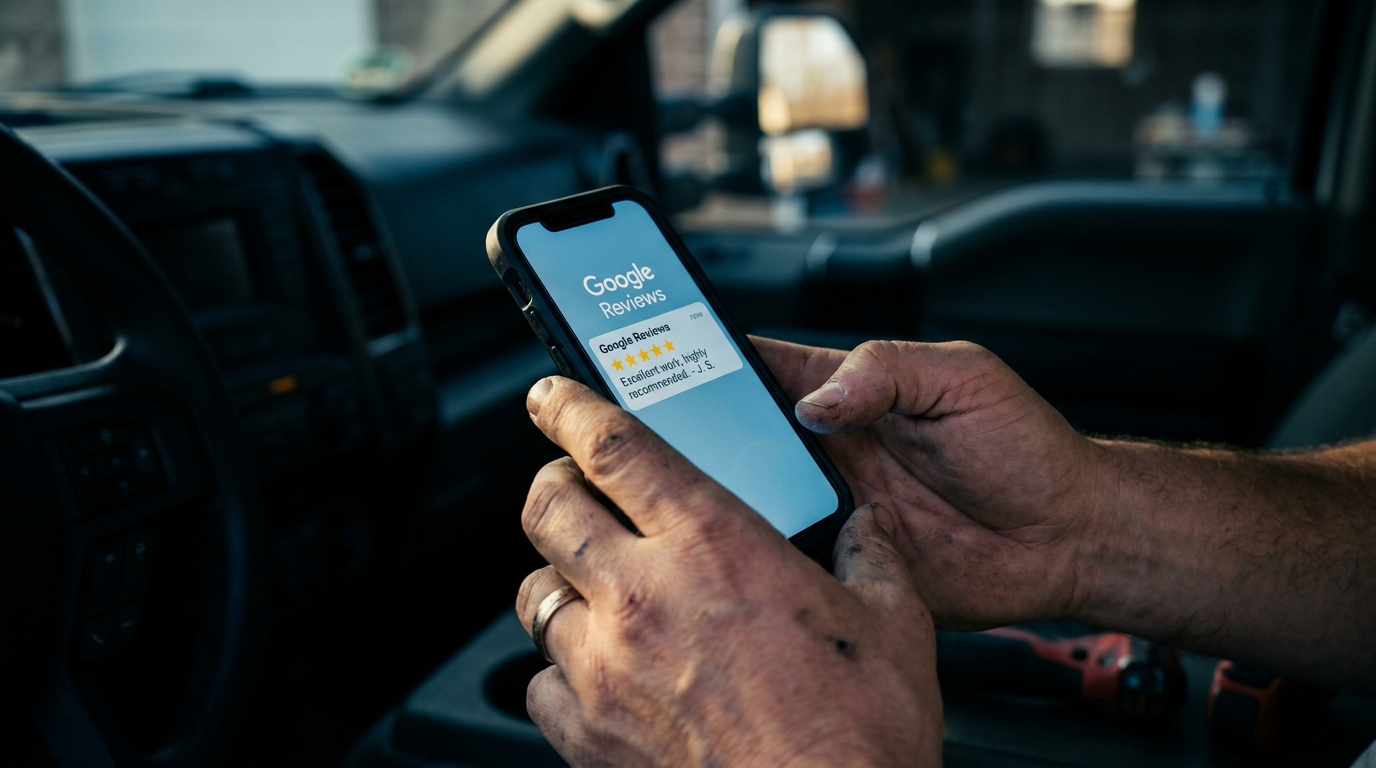
ChatGPT-cited businesses average 4.3 stars. And 47% of consumers won't use a business with fewer than 20 reviews — so both the rating and the count matter.
How to Build AI Visibility as an NWA Contractor — Six Things That Actually Move the Needle
Only 1.2% of local businesses get recommended by ChatGPT today (SOCi Local Visibility Index, 2026). But that 1.2% isn't random — they share a recognizable pattern of signals that any NWA contractor can build. These six things are what that pattern looks like, ranked by impact.
Most contractors who want to show up in AI search don't need a complicated strategy. They need to do a small number of things consistently.
1. Get your review count above 20, then keep going
47% of consumers won't use a business with fewer than 20 reviews (BrightLocal, 2026). Twenty isn't the goal — it's the floor. The contractors getting cited by AI tools have review counts well above that, and 74% of consumers specifically prioritize reviews from the last three months. That means you need a system, not a one-time ask. After every job, send a direct link to your Google review page. Make it frictionless. One job a week turning into a review is 50 new reviews a year.
2. Get your Google Business Profile fully complete
Gemini pulls directly from Google Maps. If your GBP has missing hours, a vague description, or wrong service areas, that's what Gemini sees — and either reports incorrectly or skips entirely. Every blank field in your GBP is a gap in the data AI tools use to decide whether to cite you. Fill in every field: primary category, service areas, services list, business description, attributes. Then keep it active with a post each week.
3. Add schema markup to your website
Most contractor websites have none. LocalBusiness schema with your trade type, service area, phone number, and address tells AI crawlers exactly who you are. FAQPage schema on pages that answer common questions gives AI models a clean, citable format. It's a one-time setup task that most web developers can add in an afternoon — and it's one of the clearest signals of intent to rank in AI results.
4. Build consistent citations across directories
ChatGPT and Perplexity only achieve 68% accuracy on business information (SOCi, 2026) — largely because inconsistent NAP data confuses them. Your name, address, and phone number need to match exactly across your GBP, your website, Yelp, Angi, the Better Business Bureau, and every other directory you're listed in. One wrong digit is enough to create a conflict. Audit your existing citations before you build new ones.
5. Write content that answers questions at the informational stage
AI Overviews trigger at 37.1% for informational queries and only 12.2% for "near me" queries (WebFX, 2025). The implication is direct: a contractor whose website answers "how long does a water heater last" or "signs your AC needs replacing" is visible at the stage where AI Overviews appear. A contractor whose website only lists "water heater installation" and "air conditioning repair" is not. You don't need a blog with 50 posts. Three or four well-written pages that answer real customer questions are enough to start competing.
6. Build third-party mentions beyond review platforms
AI models assess how often and where a business is mentioned across the web. Local news coverage, features in NWA trade publications, mentions in local community platforms, and links from other credible websites all contribute to the signal that a business is real and worth citing. This is harder to do quickly than the other five — but it's also the signal that national chains build automatically through their scale. Getting a single mention in a regional outlet or trade magazine does more for AI visibility than ten directory listings.
The contractors who show up in AI search aren't doing anything exotic. They have strong reviews, complete profiles, and a web presence that gives AI models something concrete to cite.
Frequently Asked Questions
How long does it take to start showing up in AI search results?
GBP completeness and schema markup can affect Gemini citations within weeks — Gemini pulls directly from Google Maps. ChatGPT and Perplexity update over months as their training data catches up. Review velocity matters throughout: 74% of consumers weigh reviews from the last three months (BrightLocal, 2026), and AI models reflect that same recency bias.
Does my Google Business Profile affect AI search visibility?
Yes — especially for Gemini, which pulls directly from Google Maps with 100% accuracy compared to 68% for ChatGPT and Perplexity (SOCi, 2026). A complete, active GBP is the fastest improvement you can make — it's the foundation for the review signals and category accuracy that other AI platforms eventually use.
How many reviews do I need to get recommended by AI?
AI-cited businesses average 3.9–4.3 stars by platform (SOCi, 2026), but rating alone isn't the threshold — 47% of consumers won't use a business with fewer than 20 reviews, and AI models reflect those same trust thresholds (BrightLocal, 2026). Twenty reviews at 4.5 stars is the floor; contractors who get cited consistently tend to have 40 or more.
Does "near me" search still matter if AI doesn't use proximity?
Yes. Google Maps still surfaces local businesses in 35.9% of queries using proximity as a primary signal (SOCi, 2026), and "near me" searches only trigger AI Overviews 12.2% of the time (WebFX, 2025). Proximity wins for ready-to-hire searches. AI visibility matters earlier, when someone is researching — not yet booking.
What Should NWA Contractors Do About AI Search Right Now?
AI chatbot-referred traffic grew 1,200% between July 2024 and early 2025, across retail and services categories broadly (Adobe Analytics, 2025). The contractor vertical is smaller, but the direction is the same: AI is already a real traffic channel, and that traffic goes to businesses that gave AI models something concrete to cite. Most contractors didn't notice the shift until customers started mentioning they found a competitor through ChatGPT.
The window to move first is open. The AI citation slot for "best plumber in Bentonville" or "HVAC contractor Rogers AR" isn't owned by anyone yet — at least not by an independent NWA contractor. The businesses that build strong review signals, clean structured data, consistent citations, and a website that actually answers questions will fill those slots. The ones that don't will watch the national franchises hold them by default.
If you want to know where you actually stand, ask me to look. I go through what an AI assistant can find about your business, what the contractors ranking above you have that you don't, and which gaps are costing you citations. It takes about thirty minutes, and I tell you what I find whether or not it turns into work.
For more on the traditional local ranking signals that still drive Map Pack results, see the full local SEO for contractors field guide.