Local SEO for Contractors: The Complete Guide
local seocontractor marketinggoogle business profilenwa contractors

Local SEO for Contractors: The Complete Guide

Most contractors are invisible on Google. This guide breaks down how local SEO actually works — Google Business Profile, reviews, citations, and on-page SEO — so homeowners find you first.

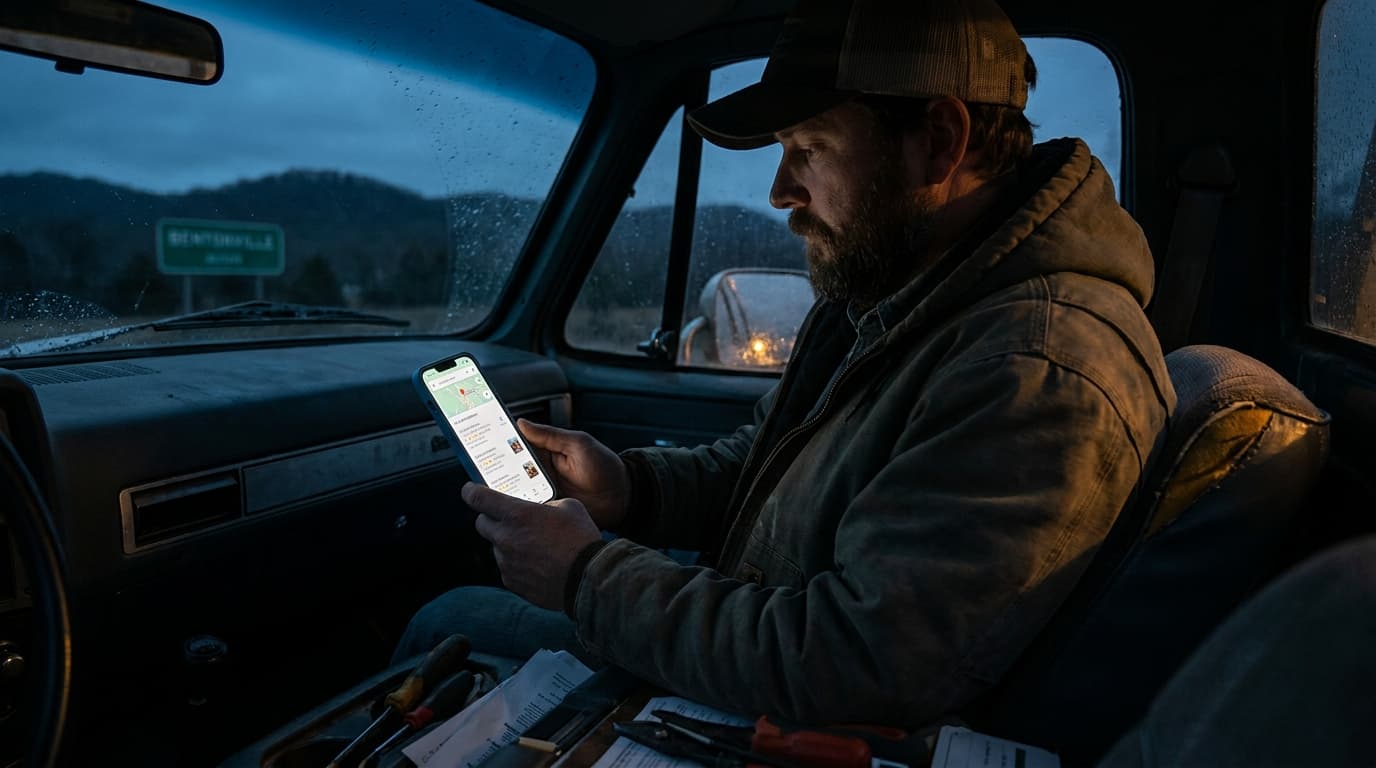
You've been in your trade for years. You do better work than half the contractors ranking above you on Google. And when someone in your city searches "HVAC repair near me" or "plumber in Bentonville," you're nowhere to be found.

That's not a marketing problem. It's a visibility problem. And it's fixable.

This guide covers what local SEO actually is, why it matters for your trade, and what to do about it. No jargon, no filler.


What local SEO actually is

Local SEO is the process of making your business show up when someone nearby searches for what you do.

When a homeowner types "electrician near me" or "roofing company Fayetteville AR" into Google, two things happen. Google shows a map with three businesses (the Map Pack), and below that, a list of websites (organic results). Local SEO is how you get into both.

It's different from regular SEO because location matters. Google isn't trying to find the best electrician in the country — it's trying to find the best one within driving distance of the person searching.

The ranking factors are different, too. Your Google Business Profile, your reviews, your citations (business listings across the web), and your website all feed into whether Google shows you or your competitor.

A diagram showing the Google Map Pack and organic results for a local contractor search A diagram showing what a Google search results page looks like for a local contractor query, highlighting the Map Pack (top 3 local results with map) and the organic website results below it.


Why contractors can't ignore this

Here's the math.

46% of all Google searches have local intent (Search Engine Roundtable). Nearly half the searches happening right now are people looking for something nearby.

88% of consumers who search for a local service on mobile call or visit within 24 hours (Think With Google). These people aren't browsing. They need someone today.

78% of local mobile searches result in an offline purchase (Safari Digital). That's a job booked, money changing hands.

The contractors who show up get those calls. The ones who don't don't — it doesn't matter how good their work is.

I talk to contractors in Northwest Arkansas all the time who've been in business 10, 15, 20 years. They have loyal customers. They get referrals. But their Google presence looks like they opened last week. Four reviews. An incomplete Business Profile. A website that doesn't mention the cities they serve.

The referrals still come in. But the moment that pipeline slows down, there's nothing catching the overflow. Local SEO is what fills that gap.


The five pieces that matter

Local SEO is five things working together. Skip one and the others suffer.

  1. Google Business Profile (your listing on Google Maps)
  2. Reviews (count, recency, and rating)
  3. Citations (your business info listed consistently across the web)
  4. On-page SEO (your website's content and technical setup)
  5. Local content (pages targeting the specific cities and services you offer)

1. Google Business Profile

Your Google Business Profile (GBP) is what shows up in the Map Pack. It's often the first thing a homeowner sees when they search for your trade, and it carries more weight than your website for Maps rankings.

Most contractors have claimed their GBP. But claiming it and optimizing it are two different things. An incomplete profile is like a storefront with the lights off.

A fully optimized profile needs:

Your business name, address, and phone number, exactly as they appear on your website and every other listing. Not close. Exact.

Your primary category should be the most specific match for your main service. A plumber picks "Plumber," not "Home Service." Add secondary categories for other services you offer.

Your business description gets 750 characters. Use them. Mention your trade, your service area, and what makes you worth calling. Write it for a homeowner, not for Google.

List every city you serve under service areas. Google uses this to decide when to show your profile in nearby searches.

Add real photos of your work, your truck, your team. Not stock images. Google has confirmed that businesses with photos get more direction requests and website clicks.

Publish Google Business Posts, short updates about seasonal tips, completed projects, or service announcements. They signal to Google that your business is active.

A screenshot of a well-optimized Google Business Profile for a contractor A screenshot showing what a fully completed Google Business Profile looks like for a home service contractor, with photos, reviews, business hours, and service area filled in.

I wrote a full step-by-step breakdown in the Google Business Profile optimization guide. If you haven't touched your profile since you first claimed it, start there.


2. Google reviews

Reviews affect two things: whether Google ranks you, and whether a homeowner actually calls you after they find you.

According to BrightLocal's 2026 Local Consumer Review Survey, 97% of consumers read reviews for local businesses (BrightLocal). And 47% won't use a business with fewer than 20 reviews.

That second number is the one that should stick. If you have 4 or 8 or 12 reviews, nearly half your potential customers are ruling you out before they even read a single one.

Review recency matters too. 74% of consumers only care about reviews written in the last three months (BrightLocal). A burst of reviews from two years ago doesn't cut it anymore. You need a steady flow.

And star ratings keep climbing. In 2026, 68% of consumers will only use a business with four or more stars, up from 55% the year before (BrightLocal).

How to get reviews consistently

The method that works best is a personal text message sent the same day as the job. Not an email blast. Not a printed card left on the counter. A text.

Something like:

"Hey [Name], thanks again for letting me take care of [walk them through what you did] — really appreciate the business. If you have 2 minutes, a Google review would mean a lot: [your review link]. Thanks!"

You'll get roughly 1 in 3 to 1 in 4 people to leave a review using this consistently. BrightLocal's data backs this up: 83% of people who were asked to leave a review actually did so (BrightLocal).

The full system is in the contractor Google reviews guide.

Responding to reviews

Collecting reviews is half of it. You also need to respond to them. All of them. 80% of consumers say they're more likely to use a business that responds to all of its reviews (BrightLocal). And 50% are put off by generic or copy-paste responses.

Thank the reviewer by name. Mention the specific work you did. It takes 30 seconds and it shows every future customer that you actually read what people say about you.


3. Citations and NAP consistency

A citation is any online mention of your business name, address, and phone number (NAP). Yelp, BBB, Angi, Yellow Pages, Apple Maps, Facebook, dozens of industry directories.

Citations do two things. They help Google verify your business is real, because the more places your info appears consistently, the more confident Google is in showing you. And they're additional places customers can find you. Apple Maps nearly doubled in usage from 14% to 27% in the last year alone (BrightLocal). If your business isn't listed there, you're missing people.

The word that matters here is "consistently." If your website says "123 Main St" but Yelp says "123 Main Street" and the BBB has an old phone number, Google gets confused. Every inconsistency weakens your signal.

What to do

  • Google your business name and check every listing that shows up. Are they all correct?
  • Fix inconsistencies. Same name, same address format, same phone number everywhere.
  • Build new citations on directories you're missing. Start with the big ones (Google, Yelp, BBB, Facebook, Apple Maps) and add trade-specific ones (Angi, HomeAdvisor, Houzz).

I have a more detailed breakdown in the citation building guide and on the citation building service page.

A checklist showing the top citation sources for home service contractors A visual checklist of the most important citation and directory sites for home service contractors, including Google Business Profile, Yelp, BBB, Angi, Apple Maps, and Facebook.


4. On-page SEO for contractor websites

A great GBP and strong reviews will get someone to click, but if your website doesn't back it up, they'll bounce.

97% of consumers use Google to evaluate local businesses (BrightLocal). 54% visit a business's website after reading positive reviews (BrightLocal). Your site has to be ready when they arrive.

Title tags and meta descriptions

Every page needs a title tag that includes your trade and your city. "HVAC Repair Bentonville AR | Your Business Name" tells Google and the searcher exactly what the page is about.

Meta descriptions don't directly affect rankings, but they affect click-through rate. A good meta description is a one-sentence pitch for why someone should click your result instead of the three around it.

Service pages

Don't cram every service onto one page. AC repair, furnace installation, duct cleaning — each one should have its own dedicated page.

Each service page should cover what the service is, the cities you offer it in, and a clear way to contact you (phone number or booking link).

Mobile

Your customers are on phones. Google knows this, so it evaluates your site based on the mobile version (mobile-first indexing). If your site is slow or hard to use on a phone, you're losing rankings and customers at the same time.

Your phone number should be a tap-to-call link. Pages should load in under 3 seconds. Text should be readable without pinching and zooming.

Page speed

60% of consumers say a business's website quality affects how they see that business (BrightLocal). A slow site makes people wonder if you run a tight operation.

Google uses Core Web Vitals (loading speed, visual stability, interactivity) as ranking signals too. Compress your images, cut unnecessary scripts, and make sure your hosting can handle the load.


5. Local content: city and service area pages

This is where most contractors fall short.

If you serve Bentonville, Rogers, Fayetteville, Springdale, and Siloam Springs, you need a page for each city. Not a bullet list on your homepage — a dedicated, unique page.

Each city page should cover the services you offer there, why homeowners in that city choose you, your phone number, and a clear next step. And the content needs to be unique. Google is smart enough to recognize when you've copied the same paragraph five times and just swapped the city name.

"AC Repair Bentonville AR" is a different search than "AC Repair Fayetteville AR." If you want to rank for both, you need content targeting both.

A wireframe showing the structure of a good local landing page for contractors A wireframe illustrating the layout of an effective city-specific landing page for contractors, showing the headline with city name, service descriptions, trust signals, and a prominent call-to-action.


The mistakes I see most often

Claiming GBP and never touching it again. You set it up two years ago, picked a category, added your phone number, and forgot about it. That profile is half empty and it's costing you Map Pack visibility.

No review system. You do great work. Your customers would happily leave a review. But you never ask, or you ask once and stop because it felt awkward.

Inconsistent business information across the web. Your name is slightly different on Yelp than on Google than on the BBB. Your old phone number is still on three directories you forgot about.

A website with no location content. Your homepage says "serving Northwest Arkansas" but doesn't mention a single city by name. Google doesn't know where to rank you because you haven't told it.

Ignoring mobile. Your customers are searching from job sites, kitchens, and driveways. If they can't call you in one tap, you've already lost them to the contractor whose number is right there.


How these pieces connect

Local SEO isn't a checklist you finish. It's a system, and it compounds.

Your GBP tells Google you exist. Reviews tell Google you're trustworthy. Citations confirm your information is accurate. Your website gives Google content to rank. Local pages tell Google exactly where you work.

Pull one piece out and the others weaken. Get them working together and you show up first when the homeowner down the street needs exactly what you do.

The contractors I work with in NWA aren't doing anything fancy. They're not running ads. They're doing the basics right, consistently, and showing up where it counts.


Where to start

If you've read this far and you're not sure where you stand, that's normal. Most contractors know their GBP exists but have no idea whether it's actually helping them.

Here's what I'd do:

Run a free audit. I built a tool that scores your local visibility in about 90 seconds. No email required, no pitch at the end. Run your free SEO audit →

Fix your GBP. It's free and it moves the needle faster than anything else. Follow the GBP optimization guide.

Start collecting reviews this week. Get your review link, send three texts today. The reviews guide has the full system.

Google your business name in quotes and check every listing for accuracy.

Look at your website like a customer would. Does it mention the cities you serve? Does every service have its own page? Can someone call you in one tap from their phone?

The best contractor in town shouldn't be the hardest to find. If that's where you are right now, it's not where you have to stay.

See where you stand — it's free →

Chad Smith

Written by

Chad Smith

Founder of Local Search Ally. Helping NWA contractors get found on Google. Based in Siloam Springs, AR.