

How to Get Google Reviews as a Contractor
78% of consumers asked for a Google review leave one. Here's the system NWA contractors use to build consistent review volume and Map Pack rankings.

Here's something most NWA (Northwest Arkansas) contractors don't realize: 71% of consumers use Google specifically to read reviews for local businesses before they hire anyone (BrightLocal Local Consumer Review Survey, 2026). Not Yelp. Not Angi. Google. And the contractors sitting at the top of the Map Pack got there — and stay there — because they treat reviews as a system, not an afterthought.
Most contractors get reviews by accident. A happy customer decides on their own to leave one. That's not a strategy. It's luck, and you can't grow a business on luck.
This post breaks down the mechanics of why reviews affect your rankings, how many you need to compete in your trade, and the specific steps that generate a consistent flow of them — without nagging customers or feeling awkward about asking.
For the full picture on local rankings, see the local SEO for contractors field guide.
Key Takeaways
- Reviews account for 15-17% of local ranking signals — the second biggest factor after GBP relevance (BrightLocal, 2025)
- 65% of customers who were asked for a review left one (BrightLocal, 2026)
- HVAC contractors need a median 244 reviews to hit the Map Pack; electricians need just 56 (Local Falcon, Jan 2026)
- 74% of consumers only trust reviews from the last 3 months — recency matters as much as total count
- Responding to all reviews makes you 80% more likely to earn a new hire vs. 47% for businesses that stay silent
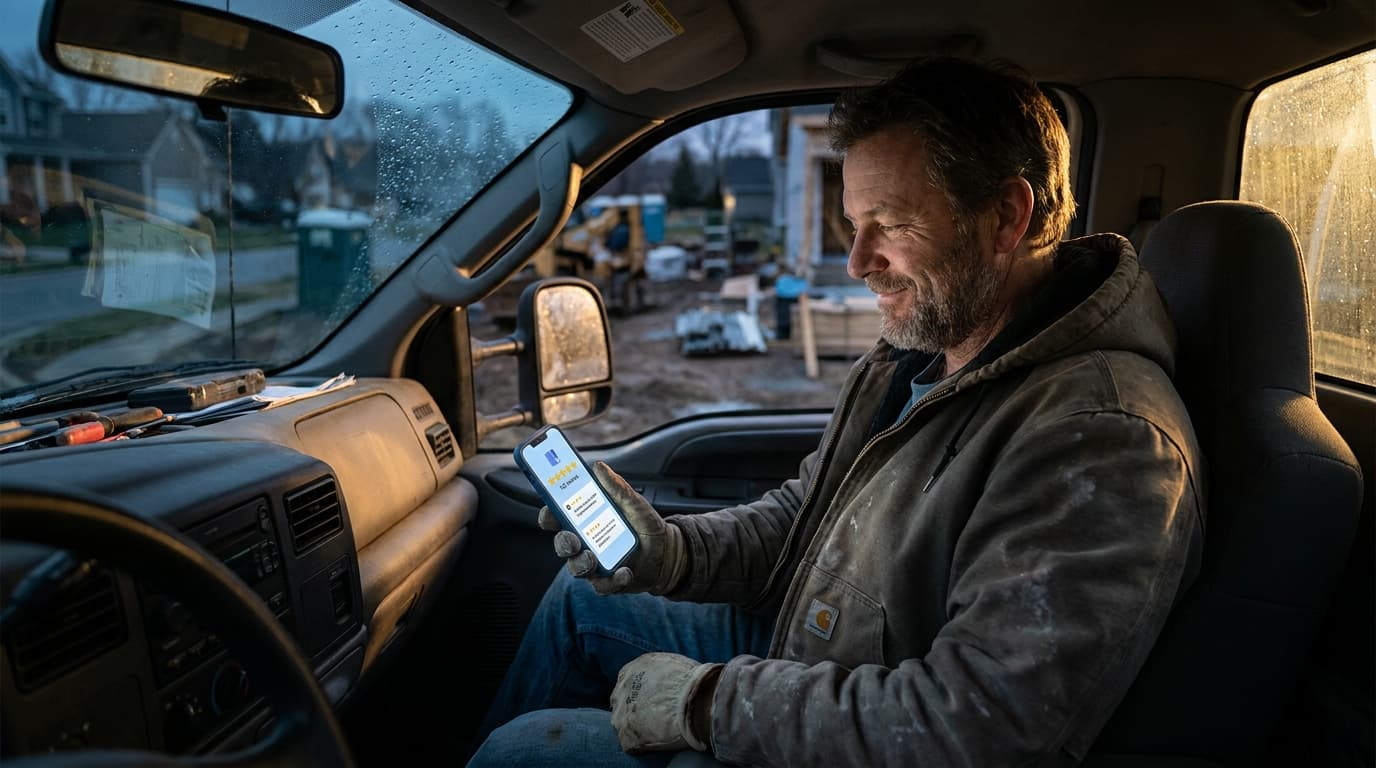
Reviews aren't vanity metrics. They're ranking signals that directly determine whether your phone rings.
Why Do Google Reviews Matter So Much for Local Rankings?
Reviews account for roughly 15-17% of local ranking signals, making them the second most important factor after GBP relevance itself (BrightLocal Local Algorithm and Ranking Factors, 2025). That's not a small slice. For many contractors, it's the gap between sitting at position 4 and sitting in the Map Pack where the calls actually come from.
Google looks at three review dimensions when evaluating your prominence: volume (how many you have), velocity (how fast you're getting them), and recency (how recent they are). Miss any one of those three and your rankings suffer — even if the other two look strong. That's why a one-time push to collect reviews doesn't hold. You need all three working together, consistently.
Median Reviews to Rank in the Map Pack by Trade — Local Falcon, Jan 2026
How Many Reviews Does a Contractor Actually Need?
The number isn't universal. It depends on your trade. A general contractor might hit the Map Pack with 28 reviews; an HVAC company in the same city may need 244 (Local Falcon whitepaper, Jan 2026, 50.4M search results). That gap exists because trade categories differ in how competitive the Map Pack is nationally and locally.
These are median counts. In a competitive NWA market like Fayetteville or Bentonville, you may need more. In a smaller market like Siloam Springs, you might need fewer. But the data tells you where the bar is set for your trade — and in most cases, it's higher than what most contractors in NWA currently have.
Star rating is a parallel concern. The typical Map Pack winner holds 4.8-4.9 stars (Local Falcon whitepaper, Jan 2026). A rating of 4.5-4.7 is the minimum floor to compete, and 31% of consumers won't even consider a business with under 4.5 stars — up from 17% the prior year (BrightLocal Local Consumer Review Survey, 2026). Volume and star rating are independent ranking signals. Neither compensates for the other.
What does this mean practically? If you're an electrician in Rogers with 12 reviews, you're not far from being competitive. If you're an HVAC contractor in Fayetteville with 40 reviews, you're not even halfway to the median threshold. Knowing your number changes how you prioritize.
Why Does Review Recency Matter as Much as Your Total Count?
Recency isn't a soft preference — it's a hard ranking factor. 74% of consumers only trust reviews written in the last 3 months (BrightLocal Local Consumer Review Survey, 2026). Google knows this. The algorithm treats fresh reviews as stronger prominence signals than old ones, no matter how many you've accumulated total.
Joy Hawkins at Sterling Sky documented a consistent pattern in controlled tests: businesses that stopped getting reviews saw measurable ranking drops, even when their total count was high (Whitespark, 2025). The Map Pack position didn't hold. It slipped. Review velocity matters as much as total volume.
Sterling Sky ran three controlled tests and observed measurable Maps ranking increases at exactly 10 reviews in all three cases (Sterling Sky, 2025). But that's not a one-time finish line. Rankings that come from review velocity require ongoing velocity to maintain. Stop asking, and within 90 days you're fighting to hold a position that used to feel comfortable.
So the goal isn't to reach a number. It's to build a habit that produces a steady flow. Two or three reviews per month is enough to maintain freshness in most NWA markets. The system in section 5 below makes that achievable without adding hours to your week.
How to Ask for a Review — Timing, Method, and What to Say
The data on asking is straightforward: 78% of consumers were asked for a review in the past year, and 65% of those people actually left one (BrightLocal Local Consumer Review Survey, 2026). That's not a low conversion rate. Most contractors just aren't asking.
Timing is the biggest variable. The best moment to ask is within 10-15 minutes of completing the job — when the customer just saw the problem fixed, the mess cleaned up, and everything working again. That's peak satisfaction. Ask an hour later and you've already lost momentum. Ask a week later by email and the emotional window has mostly closed.
What about method? 40% of consumers prefer review requests by email, and 27% prefer an in-person ask (BrightLocal Local Consumer Review Survey, 2025). Text/SMS is growing and not yet captured cleanly as a single percentage in this survey wave — but anecdotally, SMS links have some of the highest conversion rates because they're easy to tap immediately.
Preferred Channel for Review Requests — BrightLocal, 2025
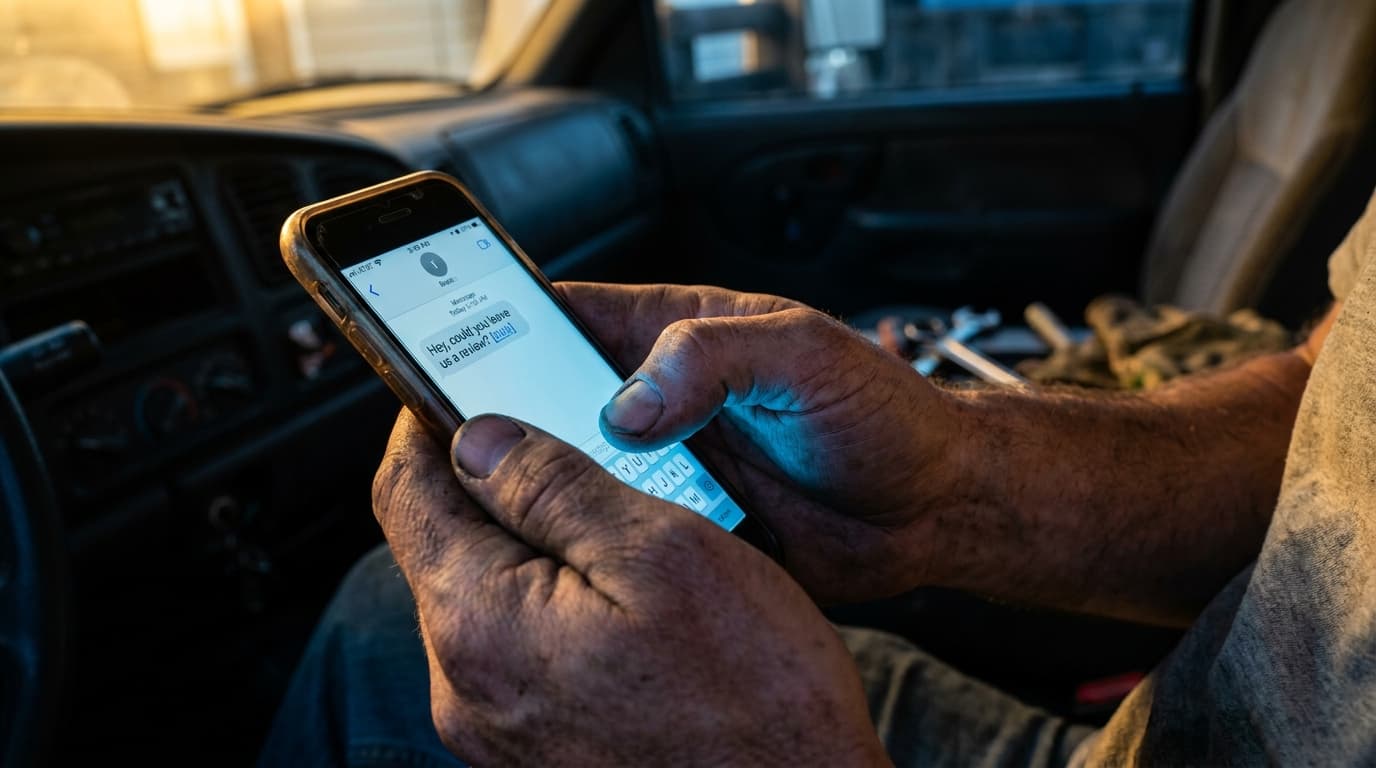
Ask within 10-15 minutes of finishing the job. That's when satisfaction is highest and the request lands best.
What to say when you ask in person:
"Hey — if everything looked good today, I'd really appreciate a Google review. It helps a lot. Can I text you a link right now?"
That's it. Short. Direct. No pressure. You're not asking them to write an essay — you're making it one tap. If they say yes, send the link immediately. Don't wait until you get to the truck.
What to say in a text follow-up:
"Hey [Name], thanks for having me out today. If you're happy with the work, a Google review means the world — here's the direct link: [your Google review link]. Takes about 60 seconds."
Contractions, casual tone, one link, no paragraph of selling. The shorter the ask, the higher the conversion.
The Three-Step Review System
This is the system that actually produces consistent results. It's not complicated. The hard part is doing it every single job, not just when you remember.
Step 1 — Create your direct review link and keep it somewhere you can access instantly.
Go to your Google Business Profile dashboard, click "Get more reviews," and copy the short link. Save it in your phone's notes, your lock screen, or as a text shortcut. You should be able to paste and send that link in under 10 seconds.
Step 2 — Ask at job close, every time.
Before you pack up, ask in person. The script above works. If the customer says yes, send the link right there. If they're in a hurry, send it within 10 minutes of leaving. Waiting until you get home at the end of the day cuts conversion significantly.
Step 3 — Send one email follow-up 24 hours later to customers who didn't click the link.
Not everyone will tap the link on the spot. A single follow-up email the next day recovers a meaningful percentage of those. Keep it even shorter than the text: subject line "Quick favor — Google review," one sentence, one link. Sterling Sky's controlled tests showed measurable Maps ranking increases at 10 reviews (Sterling Sky, 2025). At 2-3 jobs per week, you can hit that in a month.
What about customers who had a bad experience? Don't ask them. This isn't about flooding Google with fake positivity — it's about making sure satisfied customers (who are the majority if you do good work) don't stay silent while the rare unhappy one leaves the only written record.
Why Responding to Reviews Is Not Optional
Responding to reviews isn't a courtesy — it's a ranking signal. 80% of consumers are more likely to hire a business that responds to all reviews, compared to 47% for businesses that don't respond (BrightLocal Local Consumer Review Survey, 2026). That's a 33-point gap. It affects whether someone calls you after reading your profile.
Consumer Likelihood to Hire by Review Response Behavior — BrightLocal, 2026
Responding to positive reviews is easy. A short, specific reply — "Thanks, John. Glad the new water heater install went smoothly. Appreciate you taking the time" — takes 20 seconds and signals to Google that you're an engaged, active business.
Negative reviews are harder. Don't argue, don't apologize profusely for things you didn't do wrong, and don't ignore them. A short, professional response shows everyone reading that you take your work seriously. Something like: "Hi [Name] — I'm sorry this didn't meet expectations. Please reach out at [phone] and I'll make it right." That's it. You're not writing a press release. You're showing future customers how you handle problems.
Set a reminder to check your reviews twice a week. Respond to everything within 48 hours. Google's own documentation on prominence mentions that review responses factor into how it evaluates your business's authority and engagement. It's not just a consumer-facing move — it feeds the algorithm.
For a deeper look at how all the GBP signals connect, see the Google Business Profile setup guide.
Frequently Asked Questions
Can I ask every customer for a Google review?
Yes — and you should. 78% of consumers were asked for a review in the past year, and 65% of those left one (BrightLocal, 2026). The math is in your favor. Use judgment on timing — ask satisfied customers at job close, not customers who had an unresolved complaint. Don't offer incentives; Google's policies prohibit that and it can get your profile suspended.
How do I get my Google review link to share with customers?
Log in to your Google Business Profile at business.google.com. In the left menu, click "Get more reviews." Google generates a short link you can text or email directly to customers. It takes them straight to the review box — no searching required. Save it in your phone so you can send it within seconds of finishing a job.
What star rating do I need to compete in the Map Pack?
The typical Map Pack winner holds 4.8-4.9 stars (Local Falcon whitepaper, Jan 2026). A 4.5-4.7 rating is the minimum floor to be competitive. 31% of consumers won't consider a business with under 4.5 stars (BrightLocal, 2026). Volume and rating are separate signals — you need both working, not just one.
Does responding to reviews actually affect my ranking?
Yes, indirectly. Google's guidance on prominence factors includes review responses in how it evaluates a business's engagement. The more direct effect is on conversion: 80% of consumers are more likely to hire a business that responds to all reviews, versus 47% for those that don't (BrightLocal, 2026). More calls, more jobs, more reviews — the loop compounds.
What to Do Right Now
Pick one job from this week. Find the customer's contact information. Send them your Google review link today with the short script above. That's it. One ask, right now, before you read anything else.
The system described here takes under five minutes per job once it's a habit. The contractors sitting at the top of the Map Pack in Fayetteville and Bentonville aren't doing anything exotic. They ask every customer, they respond to every review, and they've been doing it consistently for months or years.
If you don't know where your review signals stand right now, your total count, your pace over the last 90 days, and how you compare to whoever is ranking above you, that's worth finding out before you change anything. Ask me to look and I'll tell you what I see.